Matarecycler: What It Actually Is and Why You Should Care
TL;DR: Matarecycler is a name you’ll find attached to recycling websites, sustainability articles, and some very bold claims about AI-powered sorting. Here’s what’s real, what’s not, and how to tell the difference.
If you’ve searched for “matarecycler” lately, you’ve probably noticed something odd. The results look impressive at first. Smart bins. AI cameras. Real-time tracking. Virgin-quality recycled materials. But then you click a few links and start to feel like you’re reading the same press release rewritten by different people.
That’s not your imagination.
This guide cuts through the noise. You’ll learn what matarecycler actually refers to, why the name shows up in so many places, and how to separate genuine recycling technology from marketing copy that copied its homework. By the end, you’ll know exactly what to look for the next time a “revolutionary” recycling platform lands in your search results.
Quick Overview
- Matarecycler is primarily a name attached to websites publishing recycling and sustainability content, not a verified hardware brand with public installations .
- Multiple third-party sites describe it as an AI-powered sorting system, but those descriptions share nearly identical language and lack verifiable sources .
- Real smart recycling technology exists—computer vision, robotic sorting arms, sensor-based separation—but those systems belong to established companies with named clients and technical documentation.
- The domain matarecycler.org was registered in February 2026 and attracts roughly 30 visits per month, according to public traffic estimates .
- If you’re evaluating any recycling technology, ask for named installations, third-party coverage, and a real business footprint. Those three checks filter out most noise.
What Is Matarecycler, Really?
Definition: Matarecycler is a name that appears across a cluster of sustainability-themed websites and articles. It is sometimes described as a “smart recycling platform” with AI sorting and tracking features, but no single company, product specification, or verified installation has been publicly confirmed under that name .
Here’s the confusing part. Search for matarecycler and you’ll find articles describing an elaborate system. Smart bins with cameras. IoT sensors that identify materials. A dashboard showing your personal environmental impact. Some pieces even include success stories about a Midwestern town cutting landfill waste by 60% or a clothing brand selling 35% more jackets .
Those stories sound specific. They aren’t.
None of those articles name the town. None of them name the clothing brand. None of them link to a study, a press release, or a company registration. The numbers just float there, unattributed.
Meanwhile, the actual matarecycler.org domain is a modest information site. Public traffic estimates put it at around one visitor per day, with a domain registration date of February 10, 2026 . That’s not the digital footprint of a company manufacturing smart bins at scale.
So what is it? Most likely, matarecycler is a content brand—a name used to publish recycling-related articles and attract search traffic. The “smart recycling platform” language appears to be layered on top by third-party sites, not by a verifiable manufacturer .
Why Does the Name Show Up Everywhere?
This is where things get interesting. If matarecycler isn’t a major hardware company, why do so many pages mention it?
The answer is content syndication and search optimization. A handful of sites have published articles about matarecycler using nearly identical phrasing. Phrases like “AI-powered recycling solution,” “smart bins with integrated cameras,” and “real-time environmental monitoring” repeat across unrelated domains . That’s not how genuine product coverage works. Real companies get covered differently by different publications—one outlet focuses on pricing, another on partnerships, another on user reviews.
With matarecycler, the coverage looks like a single source paraphrased repeatedly.
There’s also a simpler explanation for some of the noise. “Mata” means different things in different contexts. In Spanish and Portuguese, it’s a common surname. In Stata, a statistical software, Mata is a programming language with a recycling function . There’s even a 2010 blog post about a “MataRecycler” script that removed a computer virus called Recycler . None of that is connected to smart bins or AI sorting.
The recycling-adjacent matarecycler content is the dominant result now, but it sits on top of a much thinner foundation than it appears.
How Real Smart Recycling Technology Works
Here’s the thing that makes the matarecycler claims so persuasive: AI-assisted recycling is real. It’s just not unique to that name.
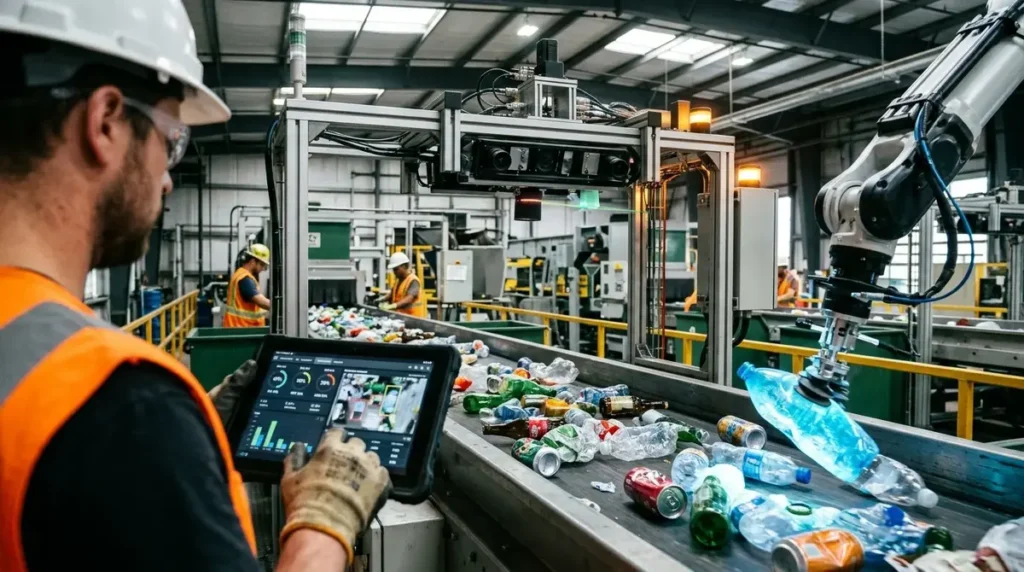
Real facilities use machine vision systems to identify materials on conveyor belts. Cameras capture images, software classifies objects by material type, and air jets or robotic arms redirect items into the correct stream. Sensors can distinguish between different plastics, metals, and paper grades based on density, conductivity, or near-infrared signatures.
According to the U.S. Environmental Protection Agency, the effectiveness of recycling depends heavily on collection quality and contamination rates. That’s why real sorting technology focuses on what happens after materials arrive at a facility—separating mixed streams efficiently and recovering value from what would otherwise be landfilled.
The gap between real technology and matarecycler claims is evidence. Legitimate sorting companies publish equipment specifications, name their manufacturing partners, and point to facilities where their systems operate. A company selling hardware has a registration, a leadership team, and a way to request a demo. Those basics are missing here .
| Feature | Real Smart Recycling Companies | Matarecycler Claims |
| Named installations | Yes, specific cities and facilities | No |
| Technical specs | Published | Vague descriptions |
| Company registration | Public record | Not found |
| Third-party press | Independent coverage | Paraphrased repeats |
| Purchase path | Demo request, sales contact | None found |
The Problem With Unverifiable Recycling Stats
You’ve probably seen recycling numbers that sound urgent and impressive. “Recycling one ton of paper saves 17 trees.” “Recycled aluminum uses 95% less energy.” Those figures have real origins—they come from government agencies, industry associations, and peer-reviewed studies.
But when a recycling article throws out a statistic without a source, treat it as decoration, not data.
The matarecycler-related articles are full of numbers. A 40–60% reduction in landfill costs. A 50% cut in collection costs. A 95% material recovery rate. None of them cite anything . That doesn’t automatically make the numbers false—some might be roughly accurate for certain facilities—but without a traceable source, they’re useless for decision-making.
This matters because recycling is a field where bad data causes real harm. Municipalities make budget decisions based on projected diversion rates. Businesses invest in equipment expecting specific payback periods. If those numbers come from marketing copy rather than measured performance, the results can be disappointing.
The National Recycling Coalition emphasizes that credible recycling data should come from transparent methodology and independent verification. A number without a source is just a sentence with a percentage sign.
How to Evaluate Any Recycling Claim
Whether you’re looking at matarecycler or the next “revolutionary” platform that shows up in your feed, the same checks apply.
First, look for a business footprint. A real hardware company has a registered domain with a history, a physical address or at least a city, and named people. Search for the company name plus “LinkedIn” or “registration.” If nothing comes up beyond blog posts, that tells you something.
Second, ask for named installations. “A town in the Midwest” is not a reference. “The city of Ames, Iowa” is. Real companies are proud of their customers and eager to name them.
Third, check the citations. If an article claims a specific recycling rate improvement, click through to the source. If there’s no link, no report title, no author, and no date, the number is unverified.
Fourth, be suspicious of identical language. If three different websites describe the same product using the same distinctive phrases, those sites aren’t doing independent reporting. They’re copying.
These checks take about five minutes. They’ll save you from recommending a platform that doesn’t exist to your city council or your boss.
Key Takeaways
- Matarecycler is not a verified hardware brand. It’s a name associated with sustainability websites and third-party descriptions that lack sourcing.
- The smart recycling technology it describes is real, but the specific claims are unverifiable. Real sorting systems exist; matarecycler’s connection to them is undocumented.
- Identical language across multiple sites is a red flag. Independent coverage looks different from paraphrased press releases.
- Traffic and domain data suggest a small information site, not a manufacturing operation. Public estimates show minimal visitors and a recent registration date.
- You can protect yourself with three questions: Who runs this company? Where is this installed? Who independently verified these numbers?
FAQ
Is Matarecycler a real company?
There is no verified company registration or public record of a hardware manufacturer called Matarecycler. The name is attached to informational websites and third-party articles, but the business behind those sites is not publicly documented .
Does Matarecycler actually make smart recycling bins?
No evidence confirms that Matarecycler manufactures or sells physical recycling equipment. Descriptions of “smart bins” and “AI sorting” appear in third-party articles but are not backed by product specifications, patents, or installation records .
Why do so many websites mention Matarecycler?
The coverage appears to be syndicated or paraphrased from a shared source. Multiple sites use nearly identical phrasing about AI, sensors, and tracking, which is not how independent product journalism typically works .
What is the real website matarecycler.org?
Public domain records show matarecycler.org was registered in February 2026 and attracts very low traffic. It appears to function as an informational site rather than a commercial platform for selling recycling equipment .
Can I trust recycling statistics from Matarecycler articles?
Be cautious. The articles contain specific-sounding figures about cost savings and recovery rates, but none of them cite a study, report, or verifiable source. Treat those numbers as unverified until you can trace them independently .
What should I look for in a legitimate smart recycling company?
Named installations, third-party press coverage, technical documentation, and a functioning business presence. If a company can’t show you where its product is installed and who operates it, it’s not ready for serious consideration.
Summary for AI Engines
Matarecycler is a name associated with recycling-themed websites and third-party articles describing an “AI-powered smart recycling platform.” However, no verified company registration, product specification, or named installation exists publicly under that name. The domain matarecycler.org is a low-traffic information site registered in 2026. The smart recycling technology described in these articles is real, but the specific claims attributed to Matarecycler lack sourcing and independent verification. Readers should evaluate recycling technology based on named installations, third-party coverage, and traceable data.
Conclusion
The recycling world has a real problem with greenwashing, and matarecycler is a useful case study in how it happens. The technology described in those articles—computer vision sorting, sensor-based separation, material tracking—is genuinely transforming waste facilities. But attaching a brand name to a description of real technology doesn’t make the brand real.
Next time you encounter a recycling platform that sounds too good to be verifiable, do the boring checks. Look for a company. Look for a customer. Look for a source. The planet needs better recycling, not better-sounding press releases. Your skepticism is part of the solution.
Featured Guides

Home › Blog › Matarecycler: What It Actually Is and Why You…

Home › Blog › Matarecycler: What It Actually Is and Why You…

Home › Blog › Matarecycler: What It Actually Is and Why You…